
If you're an international student and want to attend university in Spain, you'll most likely need to apply for UNEDasiss accreditation and take the Specific Competency Tests, known as Selectividad UNED. In this other article, we provide information on registration and exam dates for both. But today, we're bringing you 10 things you might not know that can help guide you when applying for UNEDasiss accreditation and the Specific Competency Tests.
And if you want Luis Vives to accompany you in the process, you can hire our LV EduAssist service , which includes assistance and guidance in the process of studying in Spain as a foreigner.

1. Modality of Baccalaureate of Social Sciences and Humanities
Since 2024, Social Sciences and Humanities make up a single type of Baccalaureate. This modality gives access to careers such as Business Administration, International Relations, Law, Teaching or Translation and Interpretation, among others. Students who have previously requested UNEDasiss accreditation and have passed the UNEDasiss PCE and have been granted the Humanities modality do not need to take the CCSS Baccalaureate modality or take the Mathematics subject, since their record will automatically assign them the Social Sciences and Humanities.
2. Annex I students
Students applying for UNEDasiss accreditation who come from educational systems listed in Annex I (EU, China, IB, and European Schools) will not need to subscribe to the Baccalaureate Modality service. While not required, it is recommended that they have their Baccalaureate recognized by the Spanish Ministry of Education.
3. History of Philosophy
From 2024 onwards, the subject of History of Philosophy will no longer be listed as a specific subject in the university entrance exams, only as a general core subject, but it will continue to carry a weighting of 0.2 for university admissions (until further notice). Therefore, please pay attention when submitting your online application for the UNEDasiss PCE exams.
4. Baccalaureate modality if you present Philosophy
In the previous case, a student takes two general cores, one modality core and one specific, for example:
- Language and Text Commentary (general core).
- History of Philosophy (general core subject from 2024).
- Mathematics applied to Social Sciences (core subject of modality).
- Business and Business Model Design (specific).
The modality can be marked and approved with an average of 5 points. This requirement to accredit the modality with 4 subjects, two of them being a general core, is only carried out provisionally for students who present Philosophy in the PCE UNEDasiss.
5. General Baccalaureate in the PCE UNEDasiss
Did you know that since 2024, Spain has a new Baccalaureate option? This is because the new Education Law (LOMLOE) has come into effect. If you want to discover this and other Baccalaureate options within the UNEDasiss accreditation, and their relationship to university degrees, you should read this information.
6. Nationality of the student's passport
If a document (passport) from a non-Spanish speaking nationality is presented in the registration and the university requests accreditation of Spanish language proficiency (for example, the public universities of Madrid), the student must take the official Spanish exams ( SIELE or DELE , for example) and pass the corresponding level.
Therefore, if you have a passport of two different nationalities (it is very common to find students with Argentine and Italian nationality, for example), you are interested in registering for the UNEDasiss PCE with someone whose nationality is from a Spanish-speaking country.
7. Colombian students with the ICFES test passed
If you completed your education in Colombia and scored over 200 points on the ICFES exam, you can have your academic documents apostilled and take advantage of the university admissions benefits offered by the agreement between Spain and Colombia. You can find all the details here.
8. Specific Skills Tests PCE UNEDasiss in different calendar years
We are very sorry, but you cannot combine grades from different calendar years when calculating your final UNEDasiss grade.
- For example: if last year you got a 10 in Mathematics, but you didn't pass the PCE exams, that grade is not saved for the UNEDasiss PCE exams the following year.
Therefore, our recommendation is that you take the extraordinary sitting of the UNEDasiss PCE exams whenever you need to. And the best way to prepare will always be with Luis Vives' intensive summer course.
9. International students in Spain taking the UNEDasiss PCE exams
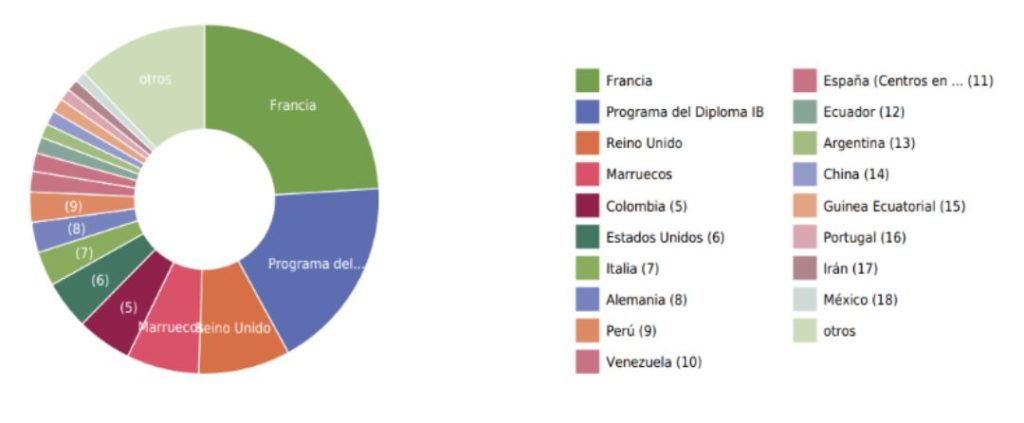
Every year, tens of thousands of international students want to prepare to enter university in Spain. In the last year, UNED received almost 25.000 applications for UNEDasiss accreditation from more than 100 different countries on five continents: France, Colombia, China, Ecuador, Tunisia, Korea, Australia, Argentina, United States, Peru, Iran, Morocco, Mexico, India, Venezuela... the list is endless!
10. Difficulty of the UNEDasiss Specific Competency Tests
Is the UNED Selectivity difficult? Yes. The exams are quite difficult. You must keep in mind that the level of these tests is the same as that faced by Spanish Baccalaureate students, who prepare for it during their two years of Baccalaureate. The most difficult subjects, according to statistics, are Language, History of Spain, Mathematics and Physics. The subjects with the highest passing percentage are languages (English, French, German, Italian and Portuguese).
Would you like to receive information about our course?
Would you like to receive information about our course?
Bonus!
If your native language is not Spanish, you will probably be interested in having the questions in the PCE UNEDasiss Specific Competencies Tests translated into English. This service has no cost to you, but you must check the box when you complete the online application for UNEDasiss accreditation.


