
uned selectivity

PCE UNEDasiss selectivity exams 2023. Luis Vives Study Center
Information about the PCE UNEDasiss tests (2026 Call)

Hello, Vivers! As every year, from our center specializing in PCE preparation, we bring you updated information on the UNEDasiss accreditation process and the Specific Competency Tests. These tests are also known as the UNEDasiss PCE university entrance exams for students with foreign high school diplomas, and you must take them if you want to study at a Spanish university.

All the UNED Managing Entities were invited to the annual UNEDasiss information session on university access at the end of last November. Since we don't want you to miss a single detail, we've summarized the most important points about the accreditation process and the Specific Competency Tests. 

If you would like Luis Vives to guide you through the process, leveraging our more than 20 years of experience, you can hire our service. LV EduAssistwhich includes assistance and advice in the process of studying in Spain as a foreigner.

Key dates for the PCE UNEDasiss specific skills tests

Below you will find the registration and exam dates for the PCE exams. Mark them down so you don't miss them!

Registration deadline for the PCE UNEDasiss 2026

As in previous years, this year you will have two registration dates to take the UNEDasiss Specific Competency Tests. One date is for the regular session and the other for the extraordinary session:

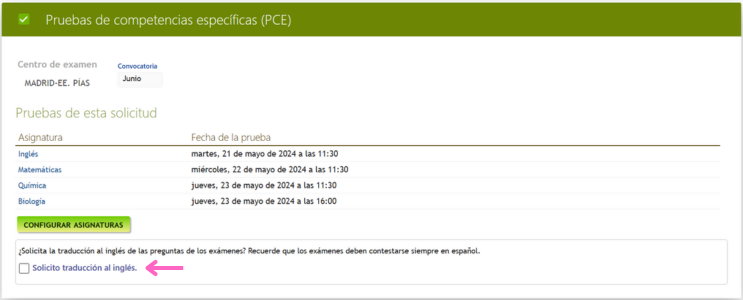
  • Ordinary call: From February 18 to April 28, 2026 for students from collaborating entities like ours or from March 16 to April 28, 2026 for independent students.
  • Extraordinary call: from 1 to 22 July 2026.

Registration will be done online. You can attach all the documentation required by UNEDasiss to take the exam. As you can see, studying with us not only provides training fully adapted to the exam, but as a UNED Managing Entity, it also gives you the advantage of being able to register for the exam earlier.

If you want to complete the PCE UNEDasiss selectivity through a UNED Managing Entity, you must register when the deadline opens. The places in the affiliated centers are limited and, if they are full, you will have to register in a center where there are free places. 

PCE UNEDasiss 2026 exam dates

In this course, the tests will be scheduled on the following dates for the regular session:

  • Ordinary call in Spain: from May 25 to 29.
  • Ordinary call in Morocco: from May 18 to 23.
  • Regular call for applications at UNED centers in America: from 10 to 13 in June.
  • Regular call for applications at UNED centers in Europe and Africa: from 8 to 13 in June.
  • Regular call for applications at non-UNED centers in America, Asia and Oceania: from June 8 to 12.
  • Regular call for applications at non-UNED centers in Europe, Africa and the Middle East: 25 29 of the May.

In the ordinary course, the exams that take place at the venues that the UNED has abroad, with the exception of Morocco, will be held in June.

The extraordinary session will be held in the first days of September

  • Extraordinary call for applications in Europe and Africa: from the 2 to the 8 for September.
  • Extraordinary call in America: September 2st – 5th

The UNEDasiss exams will be exclusively in person, Except in duly justified exceptional cases. The results of these tests are delivered approximately three weeks after they are carried out, with a deadline of June 22nd in the case of Spain.

Please note that all these dates are provisional and UNED may make changes in the following months. Although this is not common, if any deadlines are changed, we will inform you by posting the new dates in this post, so we recommend saving it for periodic review.

Optionality and competence in the PCE university entrance exams

According to the directive issued by CRUE, the Spanish Conference of University Rectors, competency-based exercises will increase significantly in the 2026 exams. These exercises, characterized by being less mechanical and requiring deeper reasoning, sometimes even with real-world applications, will become increasingly common in exams. This has led to changes in the structure of exams for some subjects, such as mathematics and language. We'll discuss these changes in upcoming blog posts, so stay tuned!

Although the structure of some tests has changed, in general, some questions remain optional, and most exams will continue to consist of one series of multiple-choice and open-ended questions. This way, students will still be able to choose some of the exercises and take advantage of this, for example, to avoid exercises they find more difficult. Thus, the preparation method for the UNEDasiss PCE university entrance exam will be similar to that of previous years, now including practice with competency-based exercises.

Since May 2025, the UNED (National University of Distance Education) has completely prohibited the sharing of exams or their solutions in any format. Therefore, study centers that prepare students for these exams had to remove their solutions from previous years' exams from their websites. However, at the Luis Vives Study Center, we know how important it is to practice with models and questions similar to those on the actual exam, which is why we created PCEtestlab. These are exams developed in collaboration with Academia Bravosol, created by our teachers using our extensive experience with these tests. This way, you can practice with models that closely mimic the structure and exercises of the official PCE exams. If you want to put your knowledge into practice, you can take a look at the... PCEtestlab exams.

Baccalaureate Modality

Students should consult the universities where they are going to apply for admission if it is necessary for their accreditation to include the baccalaureate modality. In the public universities of Madrid, it is required to prove a high school diploma to apply for admission. To do this, the old and new evaluation formula from the last year will be maintained, so you can choose between any of the two options that we show you below:

  • Old formula: students will be able to take the 3 PCE exam. You are required to score a minimum of 5 in all subjects to be able to consider the baccalaureate modality accredited. 
  • New formula: students will be able to take the 4 PCE exam. You will have to achieve an arithmetic average of more than 5 points among the four subjects to be able to consider the baccalaureate modality accredited. 

Language requirement

Students from a non-Spanish-speaking country must prove the knowledge Spanish B1. We advise you to check the level of Spanish required at the destination university itself, since currently some universities require a level B2 certified.

From our spanish department For foreign students, we will be able to advise you on everything necessary to accredit your level of Spanish.

Finally, we remind you that if you have any questions, you can contact UNED through their web page

From Luis Vives Study Center, as a collaborating entity of the UNED and a specialist center in the preparation of the PCE UNEDasiss exams, we will be able to advise you on everything you need. If you have any questions click here and get in touch with us.

Corrected UNEDasiss PCE exam.
Exclusive mock exams for the UNEDasiss PCE Selectividad ⭐ PCE TestLab

Hello, #Vivers! Are you looking for realistic exams to prepare for the UNEDasiss PCE Selectividad? Since 2025, UNED has prohibited Collaborating Entities from publishing or solving official models of the Specific Competence Tests (PCE). The only ones available are in their official Web.

That's why we created PCE TestLab, a new project developed by the Luis Vives Study Center y Bravosol Academy to help you practice with PCE simulations realistic, determined and free.

What is PCE TestLab?

PCE TestLab is a collection of PCE type exams, faithfully based on actual UNEDasiss tests. Each year, we'll add new models to offer you up-to-date preparation.

Our drills reproduce:

  • The actual structure and duration of each subject.
  • The official correction criteria.
  • The score, format and level required by UNEDasiss.

A perfect tool to practice, self-assess and Improve your performance in the Selectividad for foreigners.

Who creates the exams?

Our drills are created from scratch by teachers specializing in PCE, with more than 25 years preparing These tests. They are not generated by AI or extracted from other official models. They are original materials, designed with pedagogical criteria and academic precision.

How much do they cost?

They are completely free. You can download them from the website of the Luis Vives Study Center and the Bravosol Academy, without registration or payments.

Solved PCE TestLab 2025 exams

Here's a first collection of mock exams, prepared according to the 2025 PCE model:

Company and Business Model Design

See model 1
Watch Video

History of Philosophy

See model 1
See model 2
Watch Video

Spanish Language and Literature

See model 1
See model 2
See model 3
Watch Video

Mathematics II

See model 1
Watch Video

CCSS Mathematics

See model 1
Watch Video

All content in these exams is protected by copyright. Dissemination is permitted provided the source is acknowledged (Luis Vives Study Center). Reproduction without authorization is prohibited.

How to prepare for the 2025 PCE exam with confidence?

PCE TestLab It is a unique resource for those who take their preparation seriously.

  • Realistic simulations based on exam exercises from previous years.
  • Exclusive content
  • Correction adjusted to UNEDasiss
  • Prepared by expert PCE teachers with more than 25 years of experience.

And if you want to reinforce your training, we offer many more exercises and models like these in our intensive and annual preparation courses for the Selectividad PCE UNEDasiss 2025. Call Us, Write us o send us a WhatsApp.

We'd be happy to help you secure your university place in Spain.

Calendar and schedule for the 2025 PAU exams in Madrid, including key dates for the regular and extraordinary exam sessions.
⭐Dates and times of the 2026 PAU exams in Madrid

With the arrival of spring, thousands of second-year high school students are heading into the final stretch toward one of the most important moments of the academic year: the 2026 University Entrance Exam (PAU). In this article, we detail everything you need to know if you're taking the exam in the Community of Madrid: dates and times of the various exams.

When are the 2026 University Entrance Exams held in Madrid?

The Community of Madrid has already published the official calendar of the University Access Assessment or PAUThe regular exams will be held in June, specifically from the 3rd to the 7th, while the extraordinary exam will take place in July, from the 1st to the 4th. Below, we've detailed the exact schedules for each exam day, so you can plan your study in advance.

Schedule for the regular call for June 2026

Here are the exam schedules for the different days.

Tuesday June 3

  • 9:00 – Spanish Language and Literature (Science and Technology)
  • 12:00 – Spanish Language and Literature (Arts, General and Humanities and Social Sciences)
  • 16:00 – History of Philosophy

Wednesday June 4

  • 9:00 – English (Arts, General and Humanities and Social Sciences)
  • 12:00 – English (Science and Technology)
  • 16:00 – History of Spain

Thursday June 5

  • 9:00 – General Sciences and Mathematics II
  • 12:00 – CCSS Mathematics
  • 16:00 PM – Biology, Artistic Drawing, Technical Drawing, and Latin

Friday June 6

  • 9:00 – Physics, Artistic Fundamentals, and Geography
  • 12:00 – Art History, Chemistry and 2nd Foreign Language
  • 16:00 PM – Design, Business and Business Model Design, Geology and Environmental Sciences, and Technology and Engineering.

Saturday, June 7 (Coincidences and incidents)

This day is reserved for coincidences and incidents, but the schedule for the various exams has not yet been published.

Extraordinary call for PAU 2026 in Madrid: dates and times

The extraordinary session for the 2026 PAU in Madrid is designed for students who, for whatever reason, were unable to attend the regular session or who wish to retake it to improve their grades. Although it is held a few weeks later, it maintains a very similar structure in terms of schedules and test delivery.

Tuesday July 1

  • 9:00 – Spanish Language and Literature
  • 12:00 – History of Philosophy
  • 16:00 – Physics, Artistic Fundamentals, and Geography

Wednesday 2 of July

  • 9:00 – English
  • 12:00 – History of Spain
  • 16:00 – Art History, Chemistry and 2nd Foreign Language

Jueves 3 July

  • 9:00 – General Sciences, Artistic Drawing, Latin and Mathematics CCSS
  • 12:00 – Design, Business and Business Model Design, Geology and Environmental Sciences, Mathematics II, and Technology and Engineering
  • 16:00 PM – Biology and Technical Drawing

Friday, July 4th (Coincidences and incidents)

This day is reserved for coincidences and incidents. The schedules for these sessions have not yet been published.

PAU 2026 exam review: what to do after the tests

Once you've finished the tests, it's time to rest... but also to keep an eye on grade publication dates, complaints, and possible revisions. If you're not happy with your result in any subject, you have the right to request a second correction. In this article, we explain the process and what you should keep in mind:
➡️ How to request a review of a PAU exam step by step

At Luis Vives, we encourage you to trust in the work you've done throughout the course. The University Entrance Exam (PAU) is just another step on your path to university. Stay calm, take care of your rest, and prepare to give your best on every test.

Much encouragement!

PCE UNEDasiss Calculators 2023 - Luis Vives Study Center
[Updated 2026] ⭐Calculators allowed in the UNEDasiss PCE

If you show up to Selectivity PCE UNEDasiss, you will have doubts about what type of calculator you can take to the exam if you take some of these subjects:

  • Math.
  • Applied mathematics to social sciences.
  • Physical.
  • Chemical.
  • Technical drawing.
  • Business Economics.

Calculators allowed in the PCE UNEDasiss

The UNED, through the teaching guides for each subject, allows the following calculators:

  • Math:  the use of a calculator is not allowed. This is because the format of the test questions is now more theoretical and the calculations in progress are simple enough to not allow it.
  • Applied Mathematics for Social Sciences: Calculators are allowed unscientific and non-programmable
  • Chemistry: Calculators are allowed non-programmable scientists
  • Physics: Calculators allowed non-programmable scientists.
  • Technical Drawing: The use of calculators is permitted non-programmable scientists.
  • Business and Business Model Design (formerly Business Economics): Use of calculators is permitted non-programmable scientists.

What is a non-scientific, non-programmable calculator like?

They are the simplest ones, which can perform basic operations such as addition, subtraction, product or division. We recommend that for this type of calculator you choose those that can do square roots. We give you some examples: 

Calculator models NOT scientific NOT programmable:

  • Casio SL 310-UC
  • Casio MS-20UC
  • Office box LT-D1044
  • Liderpapel XF21
PCE UNEDasiss Calculators 2023 - Casio SL310 - Luis Vives Study Center
Casio SL 310-UC  
Liderpapel XF21 - Luis Vives Study Center
 Liderpapel XF21

How is a NON-programmable scientific calculator allowed in the UNEDasiss PCEs?

Non-programmable scientific calculators are those that allow us to perform calculations beyond the usual addition, subtraction, multiplication, or division. They are capable of calculating exponents, logarithms, trigonometric values, or expressing them in scientific notation. When purchasing a scientific calculator for use in the PCE UNEDasiss exams, we must ensure that it cannot handle matrices, systems of equations, or integrals. Our recommendation is that you purchase a calculator with a three-line display. You'll appreciate it.

Calculator models scientific NOT programmable:

  • CASIO FX-82 CW
  • CASIO FX-83GTX
  • CASIO FX-82 ms
  • CASIO FX-85 ES plus
PCE UNEDasiss Calculators - Casio FX 82 CW - Luis Vives Study Center
Our recommendation: CASIO FX-82 CW  
PCE UNEDasiss Calculators 2023 - Casio FX 82 ms - Luis Vives Study Center
The most used: CASIO FX-82 ms

What is a programmable scientific calculator like?

This is the calculator that, in addition to allowing scientific calculations, can be programmed for such useful tasks as representing functions, performing matrix operations, or calculating confidence intervals. There are other types of calculators, which, while not exactly programmable, are considered equally important for exams. These are graphing calculators and those that allow you to perform matrices or integrals, which are also not allowed on exams. The most common are any CASIO FX 991 model and any CASIO 570 model.

Calculator models programmable scientific and others not permitted:

  • CASIO FX-5800P
  • HP PRIME G2
  • Texas instruments TI-NSPIRE XII
  • Texas instruments TI-83 Premium CE python
  • CASIO FX-991SPXII Iberia
PCE UNEDasiss Calculators 2023 - Casio FX 5800P - Luis Vives Study Center
CASIO FX-5800P 
HP prime G2 - Luis Vives Study Center
HP Prime G2

What type is my calculator?

If the model of the calculator you have at home is not listed, you can tell us the model in the comments, and we will tell you what type it is. Cheer up!

Tips for the UNEDasiss PCE Language exam 2023 - Luis Vives Study Center
⭐PCE UNEDasiss 2026 Language | What the exam will be like and 5 tips

Many students encounter serious difficulties when preparing the subject of Spanish Language and Literature for the PCE UNEDasiss 2026 Selectivity. Some come from non-Spanish-speaking countries, which represents an added difficulty in preparation. If you appear soon, we will tell you what the exam is like and give you some tips to pass it.

How will the PCE UNEDasiss 2026 Language exam be?

The PCE UNEDasiss Language exam, both in the ordinary and extraordinary sessions, will last 90 minutes, will have a single option with a text and the following parts: 

  • Part 1,5: Block in which you have to briefly answer a question related to linguistic diversity, which has a total value of XNUMX points. This block offers only one question.
  • Part 7: Block of 3 objective questions with a total value of 6 points. You only have to answer 7 of the 6 questions. If you answer all the questions, only the first 0,5 will be corrected. Each correct answer counts for 0,15 points, each wrong answer subtracts XNUMX points, and blank questions do not count. There is only one correct answer ―a), b) or c)― for each question.
  • Third part: Block in which you have to write an argumentative text that has a total value of 2,5 points. In this block, two options are offered (A and B); you only have to choose one of them.
  • Part 3: Block in which you have to develop a literary theme that has a total value of XNUMX points. In this block, two options are offered (A and B); you only have to choose one of them.

Five tips to improve your results on the Language exam

Spanish Language and Literature is a subject in which essential knowledge is acquired for any competent speaker of our language, as it helps us express ourselves in a more correct and appropriate way and be aware of the mechanisms that our language makes available to us.  

Facing the study of this subject will not be difficult if you follow these tips:

  1. Practice texts. A very common mistake when preparing for this subject is to think that you can get a good grade just by memorizing concepts. All the theoretical knowledge you have acquired must always be accompanied by practice. Train your reading comprehension and writing skills: read texts, summarize them, write arguments. The exam models already solved (you have many on our website) will serve as a guide.
  1. Pay attention to the literature. The most important thing is that you do not leave the study of literature to the last minute: organize yourself, make outlines and be very clear about which authors are included in each topic. It is also important that you do not read them all “at once”, but that you intersperse the study of literary movements with other topics because, otherwise, it is very likely that you will begin to mix data and a hodgepodge of names will form in your head. It is also advisable that you be aware of the context in which each literary movement is inserted because, in the end, the works of that period are the result of the moment in which they are living. 
  1. Spend time reading the text and questions. It is important that you read the text from which the exam starts as many times as necessary, since many of the questions deal with its content. Reading it just once and starting to answer the exam will only mean you have to go back to the text again and again to locate what you need, making you waste very valuable time. Read the statements carefully and stick to answering what is asked. Don't digress.
  1. Take care of spelling. What you write is as important as how you write it. If points are deducted for spelling errors in all subjects, in this specific subject the criteria are more rigid. Review spelling rules and the use of punctuation marks, as they are essential. It is very annoying to have made an effort to study, answer the questions well and see how your grade decreases because of mistakes, accent marks or even handwriting.
  1. Control time and space. You must adjust to the time you have. If you know what the test you are taking is going to be, you will already know its structure and that will help you estimate how much time you can dedicate to each question so that you have time to take the entire exam. If you have a limit of pages in your test, calculate beforehand how much you can extend in each exercise so as not to have space problems. 

It would be advisable for you to do mock exams at home, as they will help you calculate these two parameters. To do this, you have at your disposal on our website both exam models , the solved exams from previous years, both from selectividad PCE UNEDasiss and PAU. In addition, in our youtube channel, You will also be able to see the explanation of some exams solved by our teachers. 

We wish you the best of luck!

Tips for the UNEDasiss PCE Biology exam 2023 - Luis Vives Study Center
⭐PCE Biology UNEDasiss 2026 | What the exam will be like and 5 tips

In Spain, Health careers are in fashion. There are many students who come to our country with the aim of accessing degrees such as Medicine, Dentistry or Nursing. If that is your case then you will most likely have to prepare the Biology subject for the PCE UNEDasiss of 2026. We help you!

What will the PCE UNEDasiss 2026 exam be like? Biology

On the day of the UNEDasiss Specific Competence Tests, whether you take the exam in the ordinary or extraordinary session, you will find an exam consisting of 4 parts:

  • Part 2,5: This block has a total value of XNUMX points. This block offers two options (A and B). You only have to answer one of them.
  • Part 2,5: This block has a total value of XNUMX points. This block offers two options (A and B). You only have to answer one of them.
  • Part 8: Block of 2,5 objective questions with a total value of 5 points. You must only answer 8 of the 5 questions. If you answer more than 5 questions, only the first 0,5 will be corrected. Each correct answer adds 0,15 points, each error subtracts XNUMX points and blank questions do not count.
  • Part four: Block in which you have to read a text and answer all the questions about it, which has a total value of 2,5 points.

Our recommendation is that you practice with real exams from previous years. To do this, on our website you can find a large number of exam models, as como también exams of all subjects solved by our teaching team. Or if you prefer to see it on video, you also have them uploaded to our Youtube.

Five tips to improve your results on the Biology exam

Biology is a subject that is part of the subjects of the specific phase in the university entrance test, and that is part of the access route for the degrees in Sciences and Health Sciences.

It is an exciting and very interesting subject, but at the same time it is very extensive, and hence its difficulty when studying it. 

That's why we're giving you 5 tips that will help you study the fundamental and most important aspects of the Biology subject, so that when you take the 2026 UNEDasiss PCE exam, you can be prepared to answer correctly and achieve the highest possible score. These tips are also valid if you're taking the PAU, in which case, we also recommend that you take a look at the article that they've published in our collaborating center, Bravosol Academy, in which they tell you the mistakes that you should avoid making in the Biology exam of PAU of 2026.

  1. The Biology subject consists of 5 blocks. You can study them independently but don't be tempted to stop studying any of them. Everyone enters the exams. It is better to know all the contents of the syllabus than to master only part of it.
  2. This subject has a very extensive and own vocabulary; Create a glossary with these words. With short and clear definitions, so that you can identify them and use them in the appropriate context.
  3. Draw pictures. For example, one way to study the cell is by drawing pictures of its organelles. If you see exams from other years, you will be able to see that there are both questions with drawings that ask us to identify what they are, and questions in which they ask us to draw them. And, if we have practiced before, it will be less difficult for us to do it in the exam. They do not have to be artistic drawings, but they do have to be clear and in which what we want to highlight can be perfectly seen.
  4. Make summaries of the topics as you study them. They include definitions, diagrams, comparative tables. The more you work on writing and exposing the concepts of the subject, the more you will learn.
  5. Read about current events related to the show's topics. You can also watch outreach videos. Ultimately, it's about using all the tools you have, in addition to textbooks. We are surrounded by information about Biology and its relationship with our daily lives, which will help us understand the entire subject program.

Much encouragement!

Tips for the PCE UNEDasiss Geography exam 2023 - Luis Vives Study Center
⭐PCE Geography UNEDasiss 2026 | What the exam will be like and 5 tips

Even if you were not born in Spain, it is quite likely that you will have to take the Geography of Spain exam in the PCE UNEDasiss 2026, if you want to prepare for access to university degrees in Social and Legal Sciences. The average grade obtained by students who pass this subject is around 7 out of 10. With our help, we hope you reach 10 (at least!)

What will the PCE UNEDasiss 2026 exam be like? Geography of Spain

On the day of the UNEDasiss Specific Skills Tests, whether you take the May or September exam, you will encounter the following exam structure:

  • Part 4: Block of four questions on thematic development, in which you must answer only two of them. The total value of the block will be 2 points (Each question will have a value of XNUMX points).
  • Second part: Block of 10 multiple choice questions with a total value of 2 points. You only have to answer 8. If you answer more questions than required, only the first eight will be counted. They are scored as follows: A correct answer adds 0,25 points. An incorrect answer subtracts 0,1 points. Blank answers do not count.
  • Third part: Block of two practical questions, in which you only have to answer one, with a total value of 4 points.

Remember that our recommendation is that you practice with real exams from previous years. For them, on our website you can find a large number of exam models from previous years, as well as solved exams by our teachers. You can also take a look at our YouTube Channel, where you can see videos with the resolution of different exams.

Five tips to improve your results in the Spanish Geography exam

Regarding the subject of Geography, we are interested in what is taught in the 2nd year of Baccalaureate. It is a subject incorporated into the section of modality-specific subjects, easy to understand and with great content.

Here are 5 tips to make studying easier and tackle the test successfully, whether you are taking the PCE UNEDasiss, the PAU, the university entrance exam for those over 25 or the baccalaureate. If you wish, you can also take a look at the blog of our partner center, Bravosol Academy, in which they have published an article with the errors that you should try to avoid when preparing for the Geography exam.

  1. Study with maps of Spain next to you. This will help you memorize the map and locate some phenomena, both physical and human, that are seen in the matter. 
  2. Learn to solve practical exercises with a clear methodology. When facing practical exercises, it is best that you know how to structure them and a good methodology will provide you with a good basis to execute them during the test. 
  3. Know the definitions or geographical terms: the definitions are many, but they appear throughout the entire syllabus. In any case, we have to know how to define almost any geographical term. So in order not to memorize everything, it is best to understand it and thus be able to define it with our words. 
  4. Study the physical and political map of both Spain and Europe. It uses either atlases or geographic applications with interactive games, but the recognition of geographical features, as well as countries in Europe or provinces and communities in Spain, is something basic in the subject and in any exam on the subject. 
  5. Use correct geographical vocabulary. Even if we are not geographers, we must know how to explain ourselves adequately, using a rich vocabulary adapted to the subject. This will make the person examining you see that you handle geographical concepts well and know the subject.

Don't despair, grit your teeth and make one last effort.

Tips for the PCE UNEDasiss 2023 Physics exam - Luis Vives Study Center
⭐Physics PCE UNEDasiss 2026 | What the exam will be like and 5 tips.

Did you know that in recent years, among those who managed to pass the Physics subject of the PCE UNEDasiss, the average grade was higher than 7,5? If you want to access engineering, architecture or other science careers, you may have to take the Physics exam at the PCE UNEDasiss 2026. We explain what the exam is like, and if you read until the end we will give you five important tips to improve your skills. results.

What will the 2026 PCE exam be like? Physics PCE UNEDasiss

In the 2026 UNEDasiss PCE Physics exam, both in the June and September sessions, you will find 4 parts. Each part has a maximum score of 2,5 points:

  • Part 1: Two development problems, from which only one should be chosen.
  • Part 2: Two development problems, from which only one should be chosen.
  • Third part: a development problem with a statement adapted to competency-based assessment, without the possibility of choosing options.
  • Part 8: 5 multiple choice questions, of which only XNUMX need to be answered.

To obtain the full score in the development part, the result must not only be correct, but each question must also be justified and reasoned (also with words).

At the Luis Vives Study Center, we always recommend our students practice with real exams from other years. For them, we have a large number of exam models, and solved exams, which you can find both on our website and in our YouTube Channel.

Five tips to improve your results on the Physics exam

Physics tries to describe reality in a quantitative way, that is, through mathematical models. Therefore, the better your level of Mathematics, the easier your learning of Physics will be. However, Mathematics is not everything, there are also a series of concepts behind it that must be understood. And there are times when understanding these concepts can better strengthen the Mathematics behind it. Therefore, these tips are valid no matter what level you have 🙂

Below we leave you the 5 key points that we believe can help you prepare for your university entrance exam for Physics PCE UNEDasiss in 2026, although they are also valid for other Selectividad exams: PAU | EvAU | EBAU, over 25s, and even access to higher grade training cycles. If you are going to take the PAU, we recommend that you this article from our collaborating center, Academia Bravosol, where they tell you what the Physics exam will be like and the mistakes you should avoid making in it.

  1. Practice with the calculator you are going to take to the exam. It may seem obvious, but mastering your work material is essential. There are many errors that can come from not having written scientific notation properly, from errors in parentheses levels or from confusion with radians and degrees. Plus, if you know your work tools you will go faster!
  1. Always do the exercises cleanly. That is, solve the exercises you do to practice as you would do them in an exam. Well organized, legible and beautiful. At first it will take longer, but as you get used to it, it will come naturally. And whoever corrects you will want to give you a higher grade if you make their life easier 😉
  1. Explain the ideas as if you were teaching the person reading you. Explaining your developments helps you connect physical ideas much better. In addition, the exercises can be followed more easily and you will show that you know a lot.
  1. Solve algebraically and then substitute the data. That is, first solve for the magnitude you want to calculate from the equation instead of substituting the data and then solving. For example, if the exercise asks you to calculate how far apart you have to place two charges so that they feel a certain force, we first solve for the distance from Coulomb's law and then we will substitute the data of the charges and the force. Many errors can come from doing an intermediate calculation wrong, while this way you only have to enter the data into the calculator once.
  1. Ask yourself if your results make physical sense.  You can detect an error in an exercise due to a result that does not make sense. For example, if you are calculating a speed, you can know that that result is wrong if it is greater than the speed of light. And so with distances, temperatures, energies,…

Don't despair, grit your teeth and make one last effort.

Enrollment at Madrid University 2023 - Luis Vives Study Center
[Updated 2026] ⭐ Registration at the University in Madrid step by step

If you have to register at the university in Madrid in 2026, we will help you do the process step by step. This article is useful for you if you have applied to:

If you prefer to watch it on video, we recommend you watch our YouTube video where we explain the process step by step.

To pre-register you can click here, or search for “Madrid university pre-registration” on Google. For students +25, +40 or +45, the link is this.

Remember that this year 2026 the deadline to pre-register is from June 7 to June 28. The list of those admitted will be published on July 12, and claims will be made on July 12, 15 and 16.

Before carrying out the pre-registration process, it is best that you have on your PC the identity document (front and back) and the card with your qualifications in the Selectivity, both in PDF format.

If you access the link indicated above, you will see that the first thing you must do is create a user. It is a very simple process that you have done a thousand times on many websites.

Once the user is created you will be able to access the process. This process has three steps to complete:

  1. Personal information.
  2. Academic data.
  3. Studies to request.

Personal details necessary for enrollment in the university in Madrid in 2026

In this first tab we will have to put our information: name and others, birth information and contact information. At the bottom you will see how you can choose any of the four ways in which you are going to apply for a place at the university in Madrid: 

  • University entrance tests (EvAU, PAU).
  • Foreign educational systems (UNEDasiss accreditation).
  • Vocational training.
  • Official university degree and equivalent titles.

If your access has been by people over 25, 40 or 45, you must indicate the correct route.

Academic data

In this tab you must complete the academic data related to the access route you have chosen. You will complete fields such as:

  • Applied studies.
  • Year in which you finished your studies.
  • Center where you made them.
  • Branch of knowledge.
  • Inclusion in some of the special quotas: disability, high performance athletes, etc.

Studies to request

This is the most fun part of filling, because this is where You must indicate the 12 university degrees in order of preference which you would like to access. It is not mandatory that you indicate 12, you can choose less.

For this step, we recommend that you compare the cutting notese of the current year with your grades obtained (you can use our EvAU grade calculator or of PCE UNEDasiss) to know what options you would have to obtain a place in the different university degrees offered in Madrid. We recommend that you make a list of the 12 degrees in order of priority that you would like to access.

Safeguarding and uploading documents for registration at the university in Madrid in 2026

Once you have completed the three previous steps, they will send you an email with confirmation of your pre-registration. In addition to being able to review all the data you have included and the grades you have chosen, you will see a tab called “documentation”, where you can upload the documents they ask for: identification document and report card.

Enrollment at Madrid University 2023 - Luis Vives Study Center

All the data you have included in the pre-registration is saved in the cloud, so you can log out without fear. You can log back in with your username at any time if you want to review your pre-registration, upload new documentation or change something.

We hope to have helped you, but above all we hope that you manage to access the career you want. Happy summer!

Person with passport and suitcase to travel to study in Spain
Study in Spain if your Bachelor's degree is from the EU, China or IB International Baccalaureate

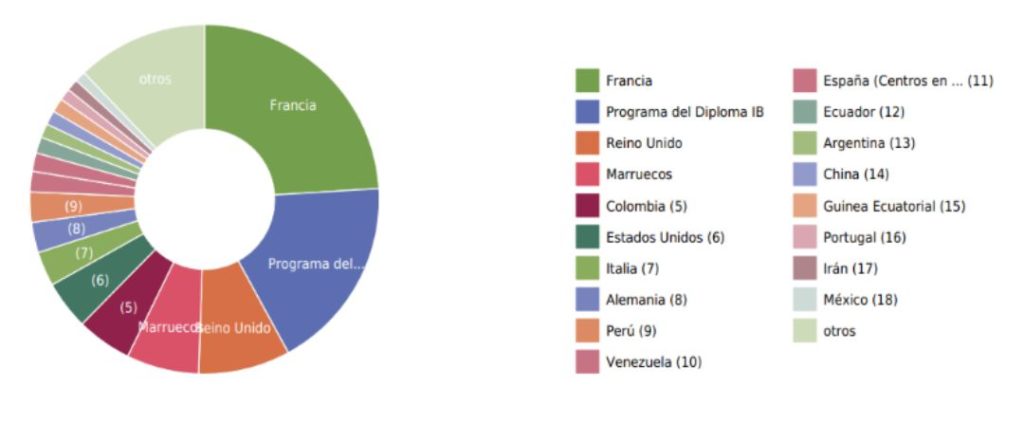
For many years now, young Europeans and Chinese have chosen Spain as a destination for their higher studies. For 25 years, at Luis Vives we have received hundreds of these students. They come to pursue a university degree or complete a cycle of Higher Vocational Training. And this is not just limited to Europeans and Chinese! Every year, Spain welcomes with open arms students of different nationalities who hold the International Baccalaureate (IB) degree. Spain is a country with many academic and professional options for those who wish to undertake an international educational experience. There are many reasons to study in Spain if you are from the EU, China or have an IB International Baccalaureate (Annex I studies).

Reasons to study in Spain

Why travel to Spain to study? If you are thinking about packing your bags and traveling to Spain to study, we hope these reasons will help you decide:

  • Educational quality exceptional: Spain boasts a solid academic tradition. You can find dozens of high-level universities throughout its geography.
  • Diversity of programs Academics: Spanish universities offer different branches of knowledge: engineering, health, business administration, etc.
  • Cultural and heritage wealth: Spain is famous for its rich culture. It has numerous museums, historical sites and artistic manifestations that will enrich your living and learning experience.
  • Gateway to Europe: Spain gives you the opportunity to get to know other countries in Europe. This is due to its proximity and the countless connections by land, sea and air.
  • Climatic and geographical diversity: In Spain you can find all kinds of landscapes. From the mountains of the north to the warm beaches of the south, passing through incredible cities like Madrid, Barcelona or Seville.
  • Enriching international experience: Studying in Spain allows you to connect with people from hundreds of countries. They choose our land as a destination for their educational and professional development.
  • Promising job prospects: Many students choose to stay in Spain after graduating. Although youth unemployment is among the highest in Europe, there are many opportunities for students with higher degrees.
  • World-renowned gastronomy: If you come to Spain you will be sure to enjoy one of the best cuisines in the world. Who doesn't know the famous Mediterranean diet?
  • Vibrant university life: In Spain, university life is vibrant, with a wide variety of activities day and night, with bars and shows that enrich the lives of all students.

Steps and documentation necessary to study in Spain if your Baccalaureate is from the EU, Chinese or IB 

To study in Spain you must meet the requirements to be admitted to a Spanish university. It is required to have a qualification equivalent to the Spanish Baccalaureate and, normally, pass a university entrance test known as UNED Selectivity: the PCE UNEDasiss Specific Competencies Tests.

  • Students with the International Baccalaureate (IB) or European Baccalaureate (EU) must have a certified copy of the International Baccalaureate diploma or Baccalaureate degree, and the IB or 2nd Baccalaureate transcript if it is European. 
  • Chinese students must translate and legalize their high school diploma (Pu Tang Gao) and national exam (Gao Kao). 
  • In most cases, students must apply for UNEDasiss accreditation and register for the Specific Competencies Tests (PCE).. These tests take place in May and September and are widely recognized by Spanish universities to admit international students. Generally, these students will take only two PCE UNEDasiss subjects. You can prepare for these tests both in a foreign country and in Spain. From anywhere, you can always choose our training online o in-person.

Once the PCE UNEDasiss tests have been passed, UNED will issue the necessary accreditation for access to the university. Your admission grade at the university will be calculated based on the grades obtained in the PCE UNEDasiss and the grades of your Baccalaureate or university entrance test in your country, depending on whether you have IB, Baccalaureate of the European Union or China .

Other important aspects if you plan to study in Spain if your Baccalaureate is from the EU, China or IB

There are some things you should keep in mind if you are thinking of studying in Spain if your Baccalaureate is from the EU, China or is an International Baccalaureate:

  • study visa: to study in Spain if you are from a non-EU country, that is, if you are from a non-European country, you must apply for a visa at the Spanish Consulate in the country of origin, proving your registration in a teaching center, your economic capacity , the home you will have in Spain and the absence of criminal records. If you are from the EU, things are much easier. Surely you will be very interested in reviewing this article that we have created with all the tips to move to Spain if you are an EU citizen, or this other one if you want emigrate to Spain as a non-EU citizen.
  • Cost of living in Spain: you must calculate the expenses related to your trip and stay in Spain, including travel expenses, housing, maintenance, lifestyle and academic expenses.
  • Adaptation to the Spanish educational system: although the educational systems of the EU, China or the IB share similarities with the Spanish one, there may be differences, such as the level of some subjects. Preparing properly is essential to achieve success.
  • You can look for support networks to help you undertake this adventure, such as agents who facilitate the procedures and transition.

We help you with everything you need to study in Spain

At the Luis Vives Study Center, in addition to offering the preparation course for the PCE UNEDasiss Specific Competencies Tests, we provide administrative, legal and academic advisory services, such as:

  • Help to apply for a study visa.
  • Assistance with the procedures upon arriving in Spain: housing, insurance, opening a bank account, contracting services, etc.
  • We advise you so that you know choose your subjects of the PCE UNEDasiss Specific Competencies Tests.
  • Registration service for UNEDasiss accreditation.
  • Information about universities in Madrid and throughout Spain, both public and private.

If you have already decided, what are you waiting for? Get going now, you can start preparing for the PCE UNEDasiss test subjects and count on our help during your trip and learning. Do not doubt contact us!

My name is Elena Barea, I am the coordinator of the PCE course and expert counselor in the UNEDasiss accreditation of the Luis Vives Study Center. I hope I've helped. Cheer up, now for 10!